
Pickleball court profitability: the realistic calculation in France
Across 200 pickleball projects delivered in 2024-2025, average measured ROI is 12 to 24 months depending on operator profile. Here are the real numbers per category: sports club, municipality, hotel, campsite, and our personalized forecast method.
Ou appelez-nous :📞 +33 6 32 22 08 55
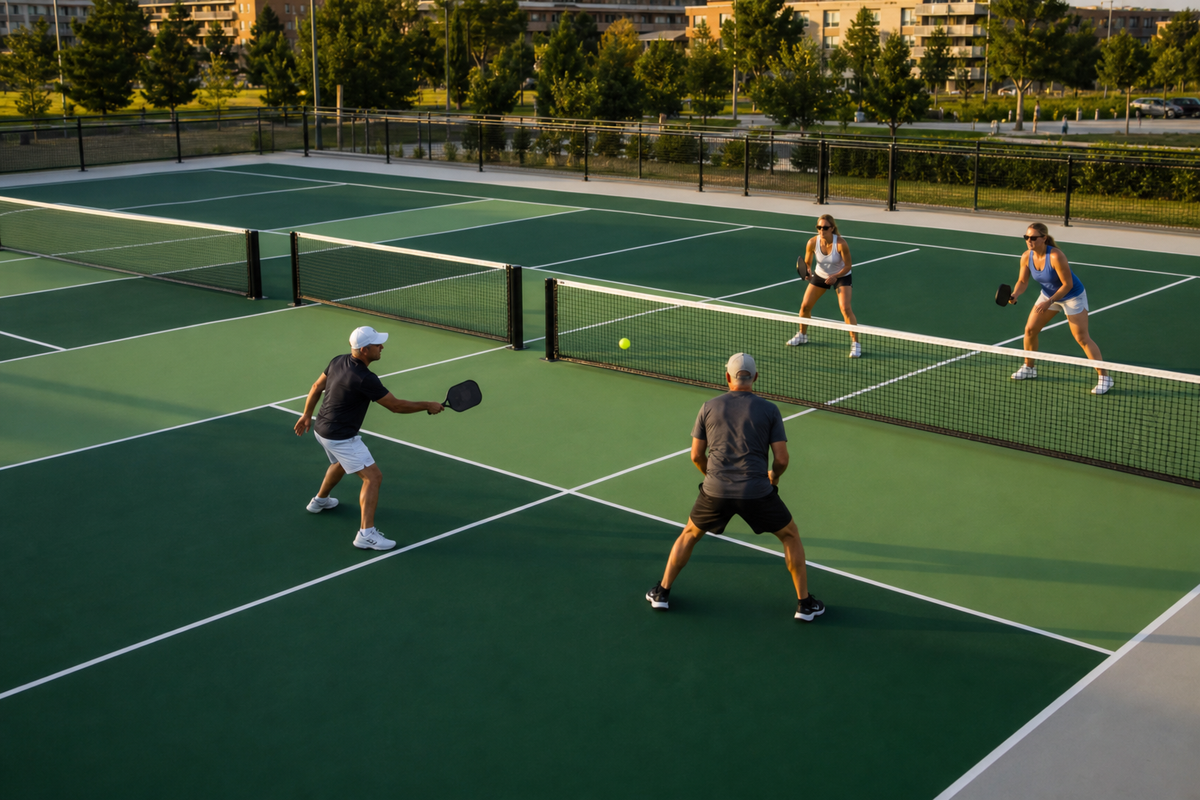
Why pickleball is the most profitable sports investment
Measured 12 to 24-month ROI
Across 200 projects delivered 2024-2025. Mix of club, hotel, campsite, municipality profiles. Pickleball pays back 5 to 10 times faster than a tennis or padel court.
5 to 8 hourly sessions per day
vs 1 to 2 for a tennis court. Short matches (15-25 min) and broad audience (intergenerational) generate 3 to 5x higher usage.
Combinable 20 to 80% grants
National grants, sports facilities plan, federations, municipal allocations. For eligible structures, net cost is divided by 2 to 5 vs catalog price.
Demand +100% annually
Pickleball gains 40,000 to 70,000 new French players per year. Demand structurally above supply, your court will never be empty.
ROI table by operator profile
Our personalized ROI calculation method
Operator profile audit
Analysis of your structure (club, hotel, campsite, municipality), target clientele, current revenue sources.
Itemized simulation
Personalized ROI modeling: investment + eligible grants + forecast revenues + operating costs. Detailed assumptions.
Financing plan
Combinable grant calculation. Financial plan presentation for your council, board, or direction.
Performance tracking
Turnkey dashboard to measure your real ROI post-opening (occupancy, revenues, member satisfaction). Comparison with our benchmarks.
The profitability of a pickleball court is never automatic in France. The sport is growing fast, but the market is still emerging: local demand is not yet guaranteed everywhere, and a court only becomes profitable if it is well located, fairly priced and, above all, actively run. This page gives you an honest calculation method, conservative worked scenarios and a clear view of the risks, so you can decide on facts rather than on unrealistic return-on-investment promises.
Pickleball in France: a promising but still emerging market
Pickleball is the fastest-growing racket sport in the world, driven by the United States and its millions of players. In France the momentum is real, but the starting point is low: the player base is counted in the tens of thousands, far behind the maturity seen in the United States or Spain. The Fédération France Pickleball is young, the club network is still being built, and general awareness remains limited outside the already active areas.
For your project this means two things. On one hand, court supply is still scarce: a well-positioned facility captures lightly contested demand and can become the local reference. On the other hand, you risk arriving before the demand: in a town or area with no community of players, a court can stay underused for months. Profitability therefore depends less on the sport itself than on your ability to build and run a local community. To go further into the numbers, read our analysis of the pickleball market in France and the pickleball court builder page.
How a pickleball court's profitability is really calculated
A serious profitability calculation combines three blocks: the upfront investment, realistic revenue and operating costs. Many short-payback promises ignore the last two, especially the cost of running the court. The real payback period then follows simply: net investment divided by net annual revenue.
Upfront investment by range
The cost of a court depends mostly on the surface type and the state of the base. On an existing slab, an outdoor court in snap-together pickleball tiles usually costs 6,800 to 9,200 € HT all in (surface, posts, net, line marking), while an acrylic pickleball court with a premium finish ranges from 14,000 to 22,000 € HT. To validate demand without a large budget, a portable pickleball court kit starts at around 350 € incl. VAT. If your project requires a new slab, earthworks or lighting, add those line items: they can represent an extra 5,000 to 15,000 € HT. The full breakdown is on the pickleball court cost page.
Possible revenue, and its limits
Court revenue comes mainly from court-time rental (8 to 15 € per hour depending on the area), beginner and improvement lessons (15 to 25 € per session per player), in-house tournaments and, for a club, the effect on memberships. In France, the key point to watch is the paid occupancy rate: it takes time to build. In the first year, a conservative assumption is often 6 to 12 paid hours per week, ramping up if a genuine community forms. Any projection that assumes a full court from opening day should, in the current French context, be treated as an optimistic scenario, not a working baseline.
Operating costs you should not forget
Maintenance of a tile or resin court stays modest (roughly 200 to 600 € per year), to which you add lighting, accessory replacement and, where relevant, insurance. The most underestimated item is the cost of running the court: to fill it you need a coach, organised slots and local communication. Whether that time is paid or volunteer, it has a value. Ignoring it completely distorts the profitability calculation. For one court, plan a direct cost budget of 1,200 to 1,600 € per year, excluding dedicated staffing.
Three worked profitability scenarios
The example below is an outdoor court in snap-together tiles laid on an existing slab, for a representative investment of 12,000 € HT (surface, net, line marking and light preparation). The three scenarios vary the only truly uncertain parameter in France: the number of hours actually rented. They include operating costs but not the value of staffing time.
| Scenario | Paid hours / week | Net annual revenue | Payback period |
|---|---|---|---|
| Conservative (weak local demand) | 6 h | around 1,400 € | 8 years or more, possibly never if demand does not take off |
| Median (community being built) | 12 h | around 4,500 € | around 3 years |
| Optimistic (strong demand and active running) | 18 h | around 8,800 € | 16 to 18 months |
The honest reading of this table is simple: the median scenario, around three years, is a reasonable planning baseline for a motivated, well-located project owner. The optimistic scenario, with a payback under two years, does exist, but it assumes an already active community and sustained running effort. The conservative scenario is a reminder that the risk is real: without local demand, a court may never pay for itself through rental alone. That is exactly why we recommend testing before investing heavily.
Request a pickleball court quote
Profitability by profile
Tennis club or sports club
This is the profile where profitability is the most direct and the fastest, because the demand and members already exist. Adding pickleball to an existing offer shares the fixed costs and the coaching skills. Conversion is particularly efficient: you can mark up to four pickleball courts on a single tennis court. See our pickleball in a tennis club, pickleball court for a club and convert a tennis court to pickleball pages.
Hotel, campsite and holiday village
For these venues, profitability is rarely direct: you do not charge for every hour of play. The court acts as a differentiation and entertainment factor that can support occupancy and guest satisfaction, especially in shoulder and low season. The effect is real but hard to attribute precisely, and you should be wary of promises of extra occupancy quantified to the percentage point. Go further with our hotel pickleball court and campsite pickleball court pages, plus our hotel pickleball ROI and campsite pickleball ROI analyses.
Local authority and municipality
For a local authority, the logic is not return on investment but public service: an accessible, intergenerational facility with low installation and maintenance costs. The real question becomes the cost per user and the share funded by grants. With a solid application, the net investment can be sharply reduced. See the pickleball court for a municipality page and the pickleball court financing page.
The factors that make or break profitability
Four levers explain most of the gap between a profitable court and one that sits idle. The first is location and footfall: a visible court near an existing flow of players or customers fills up far faster than an isolated one. The second is running the court: without a coach, organised slots and communication, even a good court stays empty. The third is pricing, to be calibrated on local purchasing power and indirect competition (tennis, padel, indoor venues). The fourth is the choice of range and its durability: a surface suited to your real use avoids premature resurfacing costs that would weigh down the long-term calculation.
Let us be frank about the risk
Investing in a pickleball court in France in 2026 means betting on demand that exists but is not yet mature everywhere. The main risk is not technical, it is commercial: a slower fill rate than expected. To manage it, the best approach is to validate demand before the heavy investment. A portable pickleball court kit or a temporary pickleball court rental let you test local appetite for a few hundred euros, observe real attendance over a season, then invest in a permanent court once demand is proven. It is better to start with one court and fill it well than to build four that are half empty.
Reducing risk and speeding up your return
Three levers clearly improve the profitability profile. First, public grants: for affiliated clubs and local authorities, schemes such as the ANS (French National Sports Agency), the DETR or regional funds can cover a significant share of the cost and reduce the capital to be paid back, as detailed on the pickleball court financing page. Next, spreading the cost through pickleball court leasing, which smooths the investment over the build-up in attendance. Finally, the test phase, which secures the decision. To structure your case, rely on our pickleball business plan guide and our investing in pickleball in France analysis.
Frequently asked questions about pickleball court profitability
How long does it take to pay back a pickleball court in France?
There is no single figure. In a realistic, well-run setting, a court monetised through rental and lessons pays back in two to four years. Where local demand is weak, payback can exceed eight years, or may never happen through rental alone. The deciding factor is the paid occupancy rate, not the surface chosen.
Is a pickleball court a safe investment?
No, it is a high-potential but risky investment, because the French market is still emerging. Demand is real in active areas and uncertain elsewhere. That is why we recommend testing demand with a portable kit before committing to a permanent court.
What revenue can a pickleball court generate?
Mainly court-time rental (8 to 15 € per hour), beginner and improvement lessons (15 to 25 € per session), tournaments and, for a club, the effect on memberships. This revenue builds over time: it requires a community of players and steady running effort.
Does the profitability calculation include costs?
Yes. A serious projection includes maintenance, lighting, accessory replacement, insurance and the value of staffing time. For one court, plan for direct costs of around 1,200 to 1,600 € per year, excluding dedicated running costs.
How do I reduce the financial risk of my project?
By validating demand before investing (portable kit or temporary rental), by securing the grants available to clubs and local authorities, by spreading the cost through leasing, and by starting with a single well-located, well-run court before any extension.
Is pickleball more profitable than padel or tennis?
For a comparable investment, a pickleball court is cheaper to install and takes up a smaller footprint, which reduces the capital to be paid back. But in France, padel and tennis demand is more mature today. Pickleball offers a better entry-cost-to-potential ratio, provided you accept the work of developing local demand.
Work out my returns with an expert
A question about your project? Call +33 6 32 22 08 55 or email support@thepickleballers-shop.com. We will prepare a costed, conservative simulation based on your profile and your local area within 48 hours.
Frequently asked questions on pickleball court profitability
Calculate your personalized ROI in 48h
Free itemized simulation: investment + grants + forecast revenues + costs. Comparison with our real benchmarks.
Ou écrivez-nous : support@thepickleballers-shop.com
★★★★★ ROI measured across 200 projects · 48h simulation · Grants included